
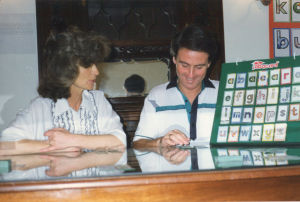
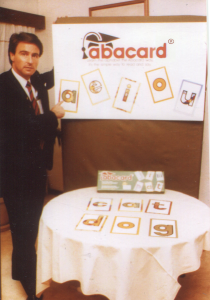
Shirley 22 August 1935 – 9 October 1990
Abacard is a tribute to its founder, Shirley, a mother of seven who, through personal struggles, created a system that would go on to change the lives of thousands of children.
In the 1980s, Shirley faced an overwhelming challenge: several of her children were struggling with reading and learning difficulties—ADHD, dyslexia, and related learning barriers that were rarely diagnosed or understood at the time. Professional help was scarce, and most parents were left to navigate these difficulties on their own. Shirley’s family was no exception.
As a mother, Shirley refused to accept that her children’s learning differences should hold them back. She tried every method available, but nothing seemed to work. It was through these personal struggles that the seeds of Abacard were planted.
Later in the 1980s, when her youngest daughter faced the same learning challenges, Shirley reached a turning point. Her daughter failed her school readiness test, labelled with “weak visual perception,” and was advised to repeat pre-primary. But Shirley knew that her daughter was bored and unchallenged by the simple tasks of cutting, colouring, and playing with sand. Her daughter pleaded with her:
“Teach me to read and write.”
Determined, Shirley persuaded the school to allow her daughter to start formal schooling on the condition that she would support her learning at home. But again, the traditional teaching tools—like the classic “A for Apple” flashcards—failed. The colourful pictures distracted her daughter, who would focus on the apple instead of the letter A.
In desperation, Shirley began creating her own system—one that focused on letter shapes and sound associations, stripped of distractions, and grounded in how we think: in symbols and images.
The breakthrough came quickly. By the end of her daughter’s first term, her teacher noted:
“She reads with confidence!”
By the second term:
“She is able to blend and record three-letter words.”
And by the end of the year:
“She reads fluently and with understanding.”
Shirley’s work didn’t stop there. She collaborated with teachers, tested the system in schools, and refined it over time. Abacard, as it became known, grew into a powerful tool that helped thousands of learners and continues to, particularly those with ADHD, dyslexia, dyspraxia, and other learning challenges.
For over four decades, Abacard has been used by foundation phase teachers, educational psychologists, special needs assistants, speech and occupational therapists, and TEFL educators, supporting learners with diverse needs.
Shirley often said:
“It’s a recognised fact that we think in symbols and images. That’s why Abacard works—it aligns with how we naturally process information.”
Abacard is not just a product; it is a legacy born from a mother’s deep love and determination to help her own children—and ultimately, to help countless others.
We are grateful to the following educators, educational psychologists, artists, and other professionals who supported Shirley in the early years while developing Abacard, including Rosemary Batchelor, Lawrence O’Toole, Gwen Erasmus, Heila Lotz, Yvonne Maxwell, Leon de Bliquy, Jean Munro, and Morette West. In the later years, Valerie Bezant, Tamarin Bedborough, Rietta Dyzel, Dianne Fawell, Chani Bruhns, Margareta Holleran, and many more offered their support.
Today, Abacard continues to change lives, helping learners build strong foundations for reading, confidence, and lifelong success.